
Seasons & episodes
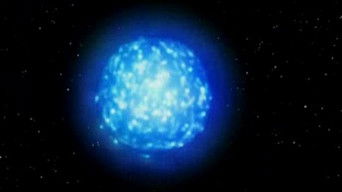 S4 · E1Death Stars 2009-08-18 · 45 min
Season 4 opens with an exploration of dying stars, the process where stars become supernovas, and, occasionally, become the biggest blast in the universe as a gamma ray burst (GRB). One death star, named WR104, lurks 8,000 light-years from Earth and some believe its GRB arrow is aimed directly at us. A death star galaxy named 3C321 is a frightening vision of what could one day befall the Milky Way galaxy: a companion galaxy's black hole being hammered with a constant blast of high-energy particles, wreaking havoc with its celestial bodies. Nearby, Death Stars Eta Carinae and Betelgeuse burn through their fuel supplies as they hurtle toward extinction...which just may be too close for comfort.
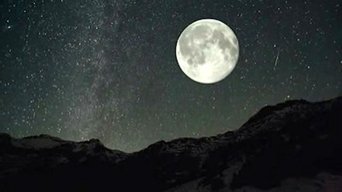 S4 · E2The Day the Moon Was Gone 2009-08-25 · 45 min
Without the moon, Earth would be a very different and desolate place today--four hours of sunlight with pitch-black nights, steady 100-mph winds spawning giant hurricanes that last for months, and virtually no complex life forms, much less humans. Safe to say, we probably owe our very existence to the moon. But what if it suddenly disappeared?
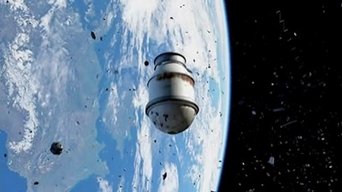 S4 · E3It Fell From Space 2009-09-01 · 45 min
Every year, thousands of objects both natural and manmade plummet through our atmosphere and crash into the Earth. These menacing messengers from the sky provide scientists with amazing insights into the natural, and not so natural, phenomena of the cosmos. From space rocks crashing through homes to cosmic boulders triggering mass extinctions to rocket parts landing on front lawns, explore objects that fall from the heavens, such as asteroids, comets, meteor showers and space debris.
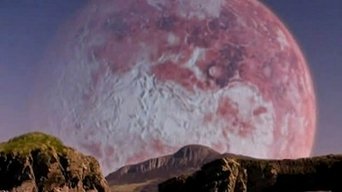 S4 · E4Biggest Blasts 2009-09-08 · 45 min
An examination of the most powerful explosions and blasts in the universe. Includes a look at the Mexico's Yucatán peninsula and the impact which caused the Chicxulub crater. Also a look at gamma rays and Big Bang Theory.
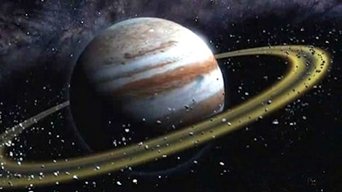 S4 · E5The Hunt for Ringed Planets 2009-09-15 · 45 min
They are breathtaking, lethal and a constant source of surprise. The stunning rings of Saturn have mesmerized countless scientists over the centuries. With particles the size of a house shooting at 53,000 miles per hour around the planet, any spacecraft passing through would meet an instant and catastrophic end. Inside the rings is like a NASCAR race - with bumping, jostling and frequent collisions that can cause a massive spin-out. Lesser known are the other planets that have rings - Uranus, Jupiter, Neptune, possibly Pluto and Mars. Even Earth has a ring. Comprised of some 200 satellites in a geosynchronous orbit, it is the only known man-made ring in the universe. But the most remarkable thing about rings is that they contain the story of the birth of our solar system, and entire distant galaxies. Rings are more than a wonder of the universe - they reveal the secrets of our own origins.
 S4 · E610 Ways to Destroy the Earth 2009-09-22 · 45 min
Experts cook up ways you could destroy the Earth, including swallowing it with a black hole, blowing it up with anti-matter, hurling it into the Sun, and switching off gravity.
 S4 · E7The Search for Cosmic Clusters 2009-09-29 · 45 min
They are the one-stop-shopping places for learning all about the nature and variety of stars in the Universe. They're unique, because in clusters, all the stars were born at about the same time, from the same material and all are at the same approximate distance from Earth. This means we can be sure that any differences among them are due to their true natures and not distorted by different distances from Earth and other factors.
 S4 · E8Space Wars 2009-10-06 · 45 min
Outer space is already an essential part of America's ability to fight wars. Our military depends on satellites for many things, such as communications, reconnaissance and targeting information. But so far, no country has put weapons into space, although the U.S. and China have both shown they can shoot down satellites with ground-based missiles. If weapons do become a part of space, how will they work, how effective will they be, and what type of damage could they do? From ground-based lasers to telephone-pole sized rods hurtling from space at two miles per second to the far out weapons of the distant future, it's time to "lock and load" for Space Wars.
 S4 · E9Liquid Universe 2009-10-20 · 45 min
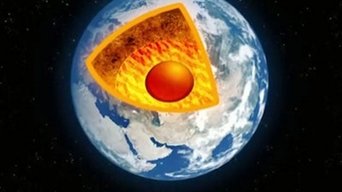
On alien planets, they rain from the sky as scalding iron. On distant moons, even at hundreds of degrees below zero, they slosh around in pristine lakes of methane. They can cover entire planets in miles-deep oceans of electrified hydrogen metal. Or erupt on alien worlds through miles-high geysers. They churn in the interiors of dead stars and even our own planet. They're so rare in the universe, they almost don't exist, but these are the magical liquids of our Liquid Universe.
 S4 · E10Pulsars & Quasars 2009-10-27 · 45 min
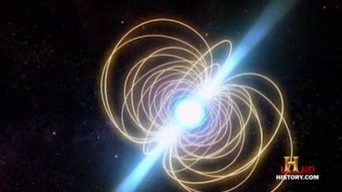
They sort of sound like the same phenomenon, but Pulsars and Quasars are very different. Pulsars are tiny--only a few miles across--but they spin as fast as a kitchen blender and sweep the sky with beacons of radiation that make them appear to flash on and off. They have unbelievably strong magnetic fields, are more accurate than atomic clocks...and they can even tell aliens just where to find the Earth! Quasars are at the other end of the spectrum. Quasars are huge cores of galaxies with black holes that are called "monsters" and which spit lobes of radiating gas called "DRAGNs." Quasars are so far away, we see them as they were only in the distant past--meaning they existed only in the early universe, when they may have played a major role in the creation of the galaxies themselves.
 S4 · E11Science Fiction, Science Fact 2009-11-03 · 45 min
Warp speed, transporters, wormholes and lasers--they are all staples of science fiction books, movies, and TV shows. But the fantastic world of tomorrow is quickly becoming the futuristic world of today. While you may not be "beaming" to your next appointment any time soon, researchers are preparing for the first tests of a present-day "transporter." And while scientists have long mocked Hollywood's visions of warp speed and faster-than-light travel as prohibited by Einstein's laws, a new generation of physicists continues to rewrite the fundamental rules of the universe. Is there a way around the cosmic speed limit? Maybe... as long as you're prepared to survive a journey through the ultra-high energies of one of the most violent places in the cosmos--the heart of a twisting, swirling vortex that leads either to strange, new worlds... or certain death.
 S4 · E12Extreme Energy 2009-11-10 · 45 min
Ours is a universe of energy, from powerful jets ejected from black holes to the raw nuclear fury of our Sun. But, the total amount of energy in the universe maintains perfect equilibrium--no more can be added or taken away. Because of this, there are enormous amounts of energy being transferred...electric, thermal, kinetic and magnetic energy are just a few that keep our universe balanced--and create awesome cosmic events and stellar displays.
 S5 · E17 Wonders of the Solar System 2010-07-29 · 45 min
A close up look at some of the most astonishing wonders of our solar system, such as the geysers of Enceladus; Saturn's amazing rings; Jupiter's Great Red Spot; and the heights of Olympus Mons on Mars.
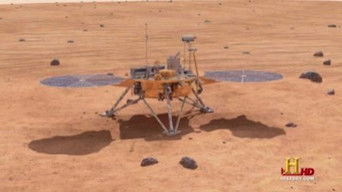 S5 · E2Mars: The New Evidence 2010-08-05 · 45 min
A look for evidence of life on Mars which provides many clues that it now, or once had supported it; from the remains of lakes and rivers that once flowed on the surface; to the water ice frozen at the poles; to the seasonal changes in methane gases that may prove bacterial life still thrives underground.
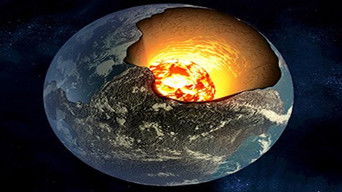 S5 · E3Magnetic Storm 2010-08-12 · 45 min
A look at magnetic storms – "Solar Katrinas" created by the sun with the power of ten-thousand nuclear weapons that could cause global electrical blackouts, electronics malfunctions and communication disasters if one should hit the Earth.
 S5 · E4Time Travel 2010-08-19 · 45 min
A look at time travel; how it could one day become reality; how Einstein's theory of relativity claims it is possible, and the probable results of traveling to the future and the mind-boggling consequences of traveling to the past.
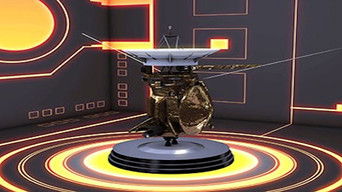 S5 · E5Secrets of the Space Probes 2010-08-26 · 45 min
A look at space probes, what they have done and found for us in space, and what they might do in the future, such as searching for Earth-like planets and for extraterrestrial life.
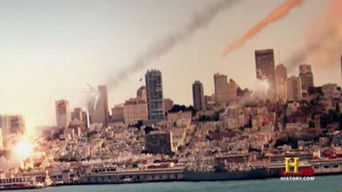 S5 · E6Asteroid Attack 2010-09-02 · 45 min
A look at asteroids and the impact they have or had on life now and before. Also, what spacecrafts can tell us about them, what they can do to civilization, and the possibility of living on one.
 S5 · E7Total Eclipse 2010-09-16 · 45 min
A look at the movements of the Earth, the sun and the moon during solar and lunar eclipses; how humans, if alone in the universe, may be the only intelligent creatures to witness these events; and how astronomers discover planets in other star systems that partially eclipse their stars.
 S5 · E8Dark Future of the Sun 2010-09-23 · 45 min
A look at the grim future of our home star, the sun, and what might happen to it five billion years in the future. Also the results of the growing sun as it kills life, including humans, if they were still around.
 S6 · E1Catastrophes that Changed the Planets 2011-10-25 · 45 min
The planets of our solar system have experienced epic catastrophes throughout their long history, both raining down from outside and bubbling up from within. We'll voyage back in time to investigate the violent events that profoundly shaped the planets, including earth itself. We'll witness stunning revelations about what transformed Mars into a barren, hostile desert...The disaster that changed Venus from temperate to hellish...The impact that blew away Mercury's mantle, turning it into a planetary core...A colossal disturbance that rearranged the orbits of the gas giants...Titanic impacts on Jupiter...And how a lost moon may finally explain Saturn's rings.
 S6 · E2Nemesis: The Sun's Evil Twin 2011-11-01 · 45 min
Could there be a monstrous, undiscovered star orbiting our own Sun? Could it be scattering killer comets throughout our Solar System like clockwork every 26 million years? New scientific surveys are probing the edges of our Solar System--a realm populated by giant worlds and mysterious planetoid--hunting for Nemesis, the Sun's purported evil twin. We may be on the verge of discovering this ultimate death star, suspected of causing every mass extinction in Earth's history. We employ everyday experiences to explain what Nemesis is and why it's been so hard to find. Experts start a wildfire on a dry California hillside, race a NASCAR around an oval track, and juggle fire, all in the effort to present how Nemesis works, and why life on Earth may depend on its discovery.
 S6 · E3How the Solar System was Made 2011-11-08 · 45 min
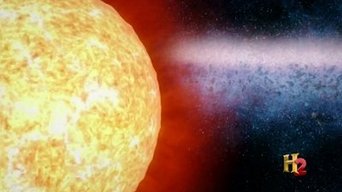
At 4.6 billion years old, the Solar System is our solid, secure home in the Universe. But how did it come to be? In this episode we trace the system's birth from a thin cloud of dust and gas. Shocked by a nearby supernova, the pull of gravity and natural rotation spun it into a flat disc from which the Sun and planets coalesced. It all happened in the space of 700 million years, during which the planets jockeyed for position, dodging the brutal bombardment of deadly asteroids and setting into the neat, stable system that we now realize might be a rarity in the universe.
 S6 · E4Crash Landing on Mars 2011-11-22 · 45 min
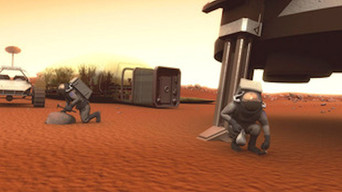
What might happen if the first manned mission to Mars crashes hundreds of miles from the rocket that would take them back home? Could they survive the crash, and travel across the brutal Martian surface to their home ship? We'll show what the astronauts would have to do to survive dust storms and space radiation, while extracting vital resources like water from the Martian soil itself. It's a dramatic vision of the very near future, where survival can depend on pre-industrial technology and human ingenuity.